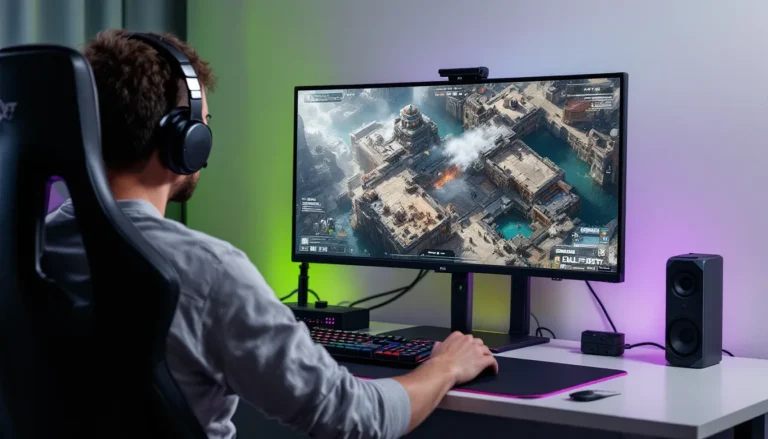
You’ve got the skills. You know the maps, you understand positioning, and your aim is solid. But you’re still getting outplayed by streamers and pro players consistently. The gap? It’s not always talent, it’s gear. The right Call of Duty accessories can reduce your input lag, improve sound localization, and give you the competitive edge that separates middle-of-the-pack performance from dominance. Whether you’re grinding ranked multiplayer, pushing for Warzone wins, or going for content creation, your setup matters. This guide breaks down exactly what accessories will level up your gameplay and why they matter in 2026.
Table of Contents
ToggleKey Takeaways
- Call of Duty accessories reduce input latency and improve audio clarity—transforming reaction time and directional awareness in competitive multiplayer.
- A monitor with 144Hz+ refresh rate and sub-3ms response time is the single most impactful peripheral after your controller, offering immediate gameplay improvements.
- Back paddles on premium controllers and mechanical keyboards with linear switches measurably speed up your reaction time by eliminating thumb repositioning and reducing actuation distance.
- Quality headsets with virtual surround sound enable tactical positioning awareness through footstep clarity and directional audio, giving you significant advantage in ranked play.
- Strategic budget allocation ($300–400 for essentials: monitor, headset, mouse/keyboard) delivers 80% of performance gains versus premium setups, proving expensive gear doesn’t guarantee wins.
- Ergonomic comfort from proper chairs, desk height, and wrist support directly impacts your ability to maintain focus and consistency during extended gaming marathons.
Why Call of Duty Accessories Matter for Your Performance
Call of Duty is built on millisecond-level precision. A headshot at 50 meters depends on your monitor’s response time, your controller’s deadzone settings, and your audio clarity to hear that incoming footstep. Accessories don’t make you better at the game itself, they eliminate friction between your brain and the action.
Consider input latency alone. A standard TV can add 80-100ms of lag. A gaming monitor cuts that to 1-4ms. That’s the difference between seeing an enemy and reacting to an enemy. Add a low-latency headset, and you’re hearing directional audio cues before your opponent even turns a corner. Stack a high-DPI mouse with a low-lag USB polling rate, and your flick shots land where you aim instead of drifting across the target.
Pro players don’t use premium gear for aesthetics. ProSettings aggregates thousands of pro player setups across Call of Duty and other competitive shooters, and the consensus is clear: low latency, clarity, and ergonomic comfort are non-negotiables at the highest level. If you want to climb the ranks or stream competitively, your peripherals are an investment, not a luxury.
The psychological element matters too. When your setup feels solid, your confidence spikes. You trust your aim, you push aggressive rotations with less second-guessing, and you stay composed during clutch moments. Conversely, a cheap rubber-dome keyboard with mushy feedback and a wired headset tangled around your neck will grind your motivation down fast.
Budget isn’t an excuse, either. This guide will show you where to prioritize your spend and where budget alternatives work just fine.
Controller Setups and Customization
Pro-Level Controller Features for Competitive Play
For console players, the controller is your interface to the game. PlayStation 5 and Xbox Series X both ship with standard controllers, but they’re not optimized for sweaty competitive Call of Duty.
The DualSense (PS5) has adaptive triggers and haptic feedback that feel amazing in campaign and casual play. For multiplayer though, many pros disable them entirely because feedback latency and vibration can throw off aim consistency. The controller’s default stick deadzone sits around 12%, which works for casual play but leaves dead space in your aim range. Dropping it to 6-8% (via in-game settings) gives you tighter control without drifting.
The Xbox Series X controller has less latency inherently and a more traditional feel, which many pros prefer. The adjustable tension sticks (available on the Elite Series 2) let you fine-tune stick resistance. This matters, a stiff stick requires more finger pressure for micro-adjustments, while a loose stick can drift. Most competitive players settle on a middle ground.
Upgrade options include:
- Xbox Elite Series 2: Customizable stick tension, back paddle mappings, and replaceable stick modules. Around $180, and it’s worth the cost if you play competitively.
- SCUF Reflex for PS5: Similar customization with back paddles and adjustable stick tension. Slightly cheaper than Elite at $150–170.
- 8BitDo Ultimate: A third-party option with solid build quality and customizable controls at $60–70. It’s a solid budget gateway into pro-level features.
Back paddles are a game-changer. Mapping jump, slide, and reload to your back fingers means your thumbs never leave the sticks. This cuts your reaction time noticeably, especially in multiplayer gunfights where movement (jumping or sliding) can break enemy aim.
Trigger-stop switches (available on Elite controllers) let you map instant-trigger pulls without depressing the full analog range. In fast-paced multiplayer, this shaves milliseconds off your shot timing, especially with burst or semi-auto weapons.
Grip and Build Enhancements
Claw grip (index finger on triggers, middle finger on bumpers) is common among pros because it preserves thumb stick control while you’re shooting. If you use this grip, you’ll want a controller with grip texture or extra material where your fingers contact the device.
The stock PS5 and Xbox controllers have slippery plastic on the grips. Cheap fix: buy a pack of thin grip tape or stick-on rubber grips from Amazon (GrifGrips, Kontrolfreek, etc.) for $10–15. They add friction without bulking up the controller.
Stick caps are another cheap accessory. KontrolFreek offers domed or convex stick caps that increase your effective stick range. A domed cap lets you push further without hitting the outer rim, giving you finer aim control. Around $15 for a pair, and pros use them constantly.
For extended play sessions (6+ hours), wrist fatigue becomes real. A controller with ergonomic contours or a grip extension case helps. The Backbone One (iPhone or Android) pairs with your phone for cloud gaming and includes a solid grip design, though it’s $99 and not essential if you’re playing on console directly.
Stick drift is inevitable over time. Replacement stick modules (found on Elite controllers and aftermarket pads) cost $10–20 and save you from buying a new controller every 18 months.
Headsets and Audio Gear for Tactical Advantages
Audio in Call of Duty isn’t background noise, it’s tactical information. Footsteps, reloads, plant/defuse sounds, killstreak alerts, and directional gunfire tell you where enemies are, what they’re doing, and when to pre-aim a corner.
The best headset for Call of Duty balances three things: comfort (for long sessions), accurate positioning (so footsteps come from the right place), and isolation (so you hear the game and not your roommate).
Wireless vs. Wired Headsets
Wireless is the standard now. USB dongles on consoles add negligible latency (under 1ms), and the freedom to move your head without cable tension is worth it. Most gaming headsets offer 20+ hour battery life, so you’re not hunting for USB ports mid-session.
Popular wireless options:
- SteelSeries Arctis Nova Pro Wireless: Built-in audio interface, dual-mode (USB + 3.5mm), and ProSettings data shows dozens of pro players using it. Around $250.
- ASTRO A50 Gen 5 (PlayStation optimized): Updated latency profile for PS5, solid surround sound. Around $300.
- Turtle Beach Stealth 700 Gen 3 (Xbox optimized): Native Xbox wireless, good build, mid-range price at $170.
Wired headsets (3.5mm jack or USB) have zero latency and never lose battery. Trade-off: a cable draped across your desk or around your neck can snag or tangle. For stationary setup, it’s fine. For streaming or content creation where you’re moving around, wireless is cleaner.
Budget picks:
- HyperX Cloud Stinger 2: Around $100, wired 3.5mm, solid isolation, lightweight.
- Turtle Beach Recon 500: $60–80, wired USB, decent surround, good value.
Surround Sound and Positioning Awareness
Here’s the critical part: surround sound (7.1 or 5.1) in a competitive headset doesn’t mean seven drivers blasting in your ear. It means virtual surround, software processing that maps directional audio into stereo drivers in a way that your brain interprets as positional.
Dolby Atmos for headphones (supported on PS5, Xbox Series X, and PC) uses elevation cues too. That enemy running above you on a second-floor balcony? You’ll hear it above your ear instead of just left/right. It takes practice to internalize, but it’s a legit advantage in multiplayer maps with vertical gameplay.
When testing a headset, load into a multiplayer match and listen for:
- Clarity of footsteps: Can you hear a single footfall clearly, or is it buried in music and ambient noise?
- Positional accuracy: When a teammate or enemy walks right to left across your field of view, does the sound track naturally?
- Bass isolation: Explosions and gunshots shouldn’t drown out footsteps. Good headsets balance bass without muddying mids where voice and footsteps live.
RTINGS has detailed headset measurements including soundstage, which correlates strongly with positional accuracy. Gamers serious about competitive play often check RTINGS reviews before committing $100+.
Microphone quality matters if you’re team-playing or streaming. Most gaming headsets include a boom mic, but quality varies. Look for noise-cancellation features (so teammates don’t hear your keyboard clicking). Mute switches are essential, you don’t want hot-mic moments during clutch plays.
One underrated accessory: a cheap 3.5mm audio splitter cable. If your headset is wired and you also want to use game chat, you can plug both your mic and headphone into a splitter, then route it to your console via a single 3.5mm jack. Solves the problem of choosing between audio and voice.
Gaming Monitors and Display Technology
Your monitor is the window between your gameplay and your brain. It’s the single most impactful peripheral after your controller or mouse. A 60Hz TV will always feel sluggish compared to a 144Hz monitor, no matter how good your aim is.
Refresh Rates and Response Times
Refresh rate measures how many times per second the monitor updates the image. 60Hz is standard for TVs. Gaming monitors run 144Hz, 165Hz, 240Hz, or higher. More Hz = smoother panning and faster visual feedback. In fast-paced shooters like Call of Duty, 144Hz is the baseline for competitive play. 240Hz starts showing diminishing returns unless you can consistently push 240+ FPS (which requires a beefy GPU).
Console players are locked by their hardware:
- PS5 and Xbox Series X cap out around 120Hz on some games (including Call of Duty: Modern Warfare 3 multiplayer).
- Most Call of Duty titles on console run 60Hz at high fidelity or 120Hz at lower graphics settings.
PC players have flexibility. If your rig pushes 240 FPS, a 240Hz monitor is worth it. If you’re hitting 100–150 FPS, a 144Hz display is the sweet spot. Don’t overspend on a 360Hz monitor if your PC can only manage 144 FPS.
Response time (measured in milliseconds) is how fast a pixel changes from one color to another. Lower is better. 1ms response time is ideal. Anything under 3ms feels responsive. Anything over 5ms starts feeling sluggish in competitive play. Panels matter here:
- TN panels: Fastest response time (1ms), narrower viewing angles, less color accuracy. Good for competitive shooters.
- IPS panels: Slower response time (3–5ms typically), better colors and viewing angles. Better for streaming or content creation where visuals matter.
- VA panels: Middle ground on response time and colors, but poor viewing angles.
Monitor latency (input lag) also matters. Some monitors add 5–10ms of processing lag on top of response time. High-end gaming monitors minimize this through native gaming modes. PCMag and RTINGS both test input latency explicitly.
Budget picks for console (144Hz+, under $250):
- BenQ EW2480: 24″, 60Hz, but cheap and clean. Holds value for casual play.
- ASUS VA24EHF: 24″, 75Hz, TN panel, $150–180, solid response time.
- Dell S2422HZ: 24″, 144Hz, 1ms response, around $200–250. Solid value play.
Resolution and Panel Types
1080p (1920×1080) is the standard on 24″ monitors. 1440p (2560×1440) on 27″ looks sharper but requires more GPU power. 4K (3840×2160) is gorgeous but crushes your frame rate unless you have high-end hardware.
For competitive Call of Duty, prioritize refresh rate over resolution. 144Hz at 1080p beats 60Hz at 4K every time. Your brain processes motion and responsiveness faster than it processes pixel density in a fast-action shooter.
Console gamers should target 24–27″ monitors. Larger screens (32″+) are cool but require sitting further back to take full advantage. At normal desk distance (24–30 inches), a 24″ monitor fills your field of view perfectly without requiring head turning.
Curved monitors (1800R curvature) add immersion and reduce eye strain on wider displays (27″+). For 24″ gaming, the curve is overkill.
Panel antiglare coatings reduce glare but add a slight matte haze. Glossy panels look sharper but show reflections. For a lit room, matte is less distracting. For a dark room or night streaming, glossy sometimes looks crisper.
One pro tip: many esports players use multiple smaller monitors instead of one large one. A 24″ primary monitor plus secondary monitors for Discord, stream chat, or map callouts keeps your competitive focus tight while maintaining awareness of other tools.
Keyboard and Mouse for PC Call of Duty
PC gaming in Call of Duty hinges on your keyboard and mouse. Console players have controller as a bottleneck (everyone uses the same hardware class). PC players have infinite hardware variation, which means your peripherals directly impact your competitiveness.
Mechanical Keyboards for Faster Response
Mechanical keyboards use individual switches under each key instead of a rubber dome. Benefits:
- Actuation point: Mechanical switches register keystroke at ~2mm of depression. You don’t need to bottom out. Less travel = faster inputs.
- Tactile feedback: You feel the keypress register, which builds confidence and consistency.
- Durability: Mechanical switches last 50–100 million keystrokes. Cheap membrane keyboards often die in 5–10 million.
- Rollover: Full N-key rollover means pressing 10+ keys simultaneously all register. This matters for complex movement inputs (sprint-jump-slide-strafe combos).
Switch types matter:
- Linear (Cherry MX Red, Black): No bump, smooth keystroke. Fastest. Most pros use these.
- Tactile (Brown, Clicky): Noticeable bump at actuation. Some players prefer the feedback. Slightly slower than linear.
- Clicky (Blue, Green): Audible click plus tactile bump. Loud. Teammates hate it on stream.
For Call of Duty, linear switches are standard. Cherry MX or Gateron switches are reliable. Knock-off switches exist at $20 keyboards but fail faster.
Keyboard layout:
- Full-size (104 keys): Standard layout, includes numpad. Most spacious.
- TKL (87 keys): No numpad, more desk space for mouse movement. Preferred by competitive players.
- 60% (61 keys): Compact, some top-row shortcuts moved to layers. Niche preference.
For Call of Duty, 60% is overkill. TKL gives you the best balance of space and accessibility.
Poll rate matters too. A 1000Hz polling rate (keyboard transmits input 1000 times per second) is standard now. 8000Hz exists on premium boards but adds negligible advantage. Don’t overspend on poll rate alone.
Budget picks:
- Corsair K60 Pro: TKL, Cherry MX switches, under $150.
- SteelSeries Apex Pro: Adjustable actuation switches, under $200.
- GMMK Pro: Budget ($100–120) with hot-swappable switches you can replace yourself.
Precision Gaming Mice and DPI Settings
Your mouse is your crosshair control. Every flick, every micro-adjustment, every pre-aim rotation flows through it.
DPI (dots per inch) measures mouse sensitivity. 400 DPI, 800 DPI, 3200 DPI, higher DPI means the cursor moves more distance per physical mouse movement. Most pros play 400–800 DPI. Higher DPI (3200+) is usually for lower-sensitivity preference (moving the physical mouse less) or for players who prefer fast, flick-based gameplay.
ProSettings data shows the mode: most pro Call of Duty players sit around 400–600 DPI with in-game sensitivity around 5–8. This lets you do a 180-degree turn with a full mousepad movement, giving you precise control and large movement range.
Acceleration should be disabled. Acceleration curves make your mouse move faster if you move it quickly, which throws off muscle memory. You want linear, predictable response.
Mouse features that matter:
- Sensor: Modern laser or optical sensors are all acceptable. Older mice with “prediction” can cause hitching.
- Polling rate: 1000Hz standard. 8000Hz exists but costs more. Not crucial for Call of Duty’s TTK windows.
- Weight: Lighter mice (under 80g) are trendy and reduce arm fatigue. Some players prefer heavier mice (100g+) for stability. Personal preference dominates.
- Cable or wireless: Wireless has no practical latency now. Wired eliminates battery concern. Both work fine.
Popular competitive mice:
- Logitech G Pro Wireless: 80g, top sensor, industry standard. Around $130.
- Razer DeathAdder V3: 63g, lightweight, popular with streamers. Around $70.
- SteelSeries Rival 650: Heavier at 95g, great ergonomics, around $80.
Mousepads matter more than people think. A cheap cloth pad with inconsistent glide can throw off your muscle memory. Invest $30–50 in a large (36×18 inch) cloth pad with consistent glide. Steelseries QCK and Corsair MP600 are standards.
One mistake: don’t match your in-game sensitivity to your friends’ just because they’re playing well. Your sensitivity should match your DPI, mousepad size, and arm length. Spend a week dialing it in during multiplayer. Once it feels natural, lock it and stop second-guessing.
Lighting and Ergonomic Accessories
RGB Lighting and Aesthetics
RGB lighting isn’t gameplay-relevant, but it’s worth touching on because setup aesthetics affect mental state and streaming appeal.
RGB (red-green-blue) LEDs on keyboards, mice, headsets, and monitors let you customize color schemes. For streaming or content creation, a cohesive RGB setup (all synchronized to one color) looks professional and branded. For gameplay, it’s purely aesthetic.
Budget tip: you don’t need RGB on every peripheral. A single RGB keyboard under a monitor with simple white or brand-color lighting is cleaner than a rainbow explosion of conflicting colors. Brands like NZXT and Corsair offer unified RGB software (NZXT CAM, Corsair iCue) that sync all your gear to one color profile.
If you’re streaming, RGB adds production value. If you’re grinding ranked play with the lights off, save the $30–50 and put it toward a better mousepad or monitor.
Lighting behind your monitor (bias lighting) is underrated. A simple USB LED strip behind your monitor reduces eye strain during long sessions by matching ambient brightness. Around $15–20 and genuinely helpful for comfort.
Desk Chairs, Mousepads, and Comfort Gear
You’re sitting in your chair for 6+ hours during gaming marathons. A cheap office chair will destroy your posture and back. A quality gaming chair ($200–400) provides lumbar support and adjustable height.
Key features:
- Lumbar support: Lower back cushioning that matches your spine’s curve. Essential.
- Armrests: Adjustable height and width so your elbows rest at 90 degrees while playing.
- Seat depth and width: Should accommodate your leg length without cutting off circulation.
- Tilt mechanism: Allows slight recline without being fully reclined (which is bad posture).
Budget picks:
- Secretlab Omega: Premium ergonomics, high-end materials, around $400.
- GTRACING Pro: Similar support at $250–300.
- IKEA Markus: Surprisingly solid for $100–150, though less customizable.
Standing desks are overkill for gaming, but a height-adjustable desk ($200–500) lets you alternate between sitting and standing, which helps circulation during 8-hour streaming sessions.
Mousepad size matters. A small 10″×8″ pad is cramped. A large 36″×18″ pad gives you plenty of room to swipe and doesn’t feel restrictive. Quality pads have consistent glide and stitched edges that don’t fray. Expect $30–60 for a good one.
Wrist rests under your keyboard and mouse reduce strain. A gel wrist rest ($15–25) fills the gap between your keyboard and desk, keeping your wrists neutral instead of bent up. Over long sessions, this prevents tendonitis.
Keyboard tilt: most keyboards ship with tilt legs that angle the keyboard up. Remove them. A flat or slightly negative tilt (back slightly higher than front) is better ergonomics than a 5-degree angle. Your wrists should be neutral, not bent upward.
Desk layout tip: position your monitor so the top of the screen aligns with your eye line when sitting upright. Monitor stands or monitor arm mounts let you adjust height without buying a new monitor. Around $30–80 for a good mount.
Console-Specific Accessories and Bundles
PlayStation and Xbox Optimized Gear
While most gaming peripherals work across platforms, some are tuned for specific consoles.
PlayStation 5 specific:
- DualSense controller features (haptic feedback, adaptive triggers) only work on PS5 games. If you pair a DualSense to PC, you lose those features. It still works, but you’re not leveraging its strengths.
- Turtle Beach Stealth 700 Gen 3 for PlayStation supports native PS5 wireless, meaning one less USB dongle cluttering your setup.
- ASTRO A50 Gen 5 has a PlayStation edition with optimized audio profiles for PS5’s Tempest 3D audio.
For content creation, Ramblings Of A Gamer covers PlayStation-specific gear in depth if you want deeper dives into PS5 setups.
Xbox Series X specific:
- Xbox Wireless headsets connect directly without USB dongles, freeing up ports.
- Turtle Beach, SteelSeries, and SCUF all have Xbox-optimized versions.
- Xbox Elite Series 2 controllers are obviously built for Xbox and offer full customization.
Cross-platform peripherals (keyboards, mice, headsets, monitors) work on both and are often cheaper than platform-specific versions. A USB-C to 3.5mm cable on a standard headset makes it compatible with any console with a 3.5mm input.
Storage and Cooling Solutions
Call of Duty is massive. Modern Warfare 3 multiplayer alone is 80–100GB. Combined with seasonal updates, you’ll blow past a console’s internal storage fast.
External storage:
- PS5: Supports NVMe M.2 SSD expansion. WD Black SN850X or Samsung 990 Pro are industry standards. Speeds matter, you need 5500+ MB/s read speed for PS5 compatibility. Around $60–120 for 1TB.
- Xbox Series X: Uses proprietary Seagate Expansion Card (1TB, around $150). Pricy but plug-and-play.
- Both consoles: External USB drives for backwards-compatible games (PS4/Xbox One titles) are cheaper and plug-and-play, but next-gen games (PS5/Series X) must run from internal storage or the expansion drive.
If you own 20+ games and actively play 5–6, you’ll definitely need storage expansion. It’s not optional at this point.
Cooling solutions:
- Console cooling fans: USB-powered fans that attach to the rear vent. Honestly, unnecessary if your console is well-ventilated. The PS5 and Series X have solid thermal designs. A cooling fan is a $30 feel-good accessory, not a necessity.
- Laptop coolers under your TV setup: If your console lives in an enclosed entertainment center, heat buildup can occur. A simple fan pointing at the intake vent helps. Around $20–40.
More important than active cooling: keep your console in an open, ventilated space. Dust is the real enemy. A can of compressed air ($8) clears dust from intake vents every 6 months and does more good than any aftermarket cooler.
Controller charging stations ($25–40) are convenient if you swap between multiple controllers. Batteries last 10–15 hours on PS5 and Xbox, so you can rotate controllers while one charges. For serious players with two controllers, a stand is solid.
Streaming and Content Creation Accessories
If you’re streaming Call of Duty or creating YouTube content, your audience cares about video and audio quality. Viewers will forgive a bad game if your setup looks and sounds professional.
Microphones and Capture Devices
Microphones are critical. Most gaming headsets include a boom mic, which is fine for team chat but subpar for streaming. A standalone mic captures your voice clearer and gives you better control over levels.
Popular streaming mics:
- Audio-Technica AT2020 USB+: Cardioid condenser, ~$100. Picks up your voice clearly without needing an audio interface.
- Blue Yeti: Plug-and-play USB, multiple pickup patterns, around $70.
- Shure SM7B: Industry standard, ~$400. Overkill unless you’re a full-time streamer, but the gold standard.
Mic placement matters. A boom arm ($30–60) positions the mic 6 inches from your mouth, off to the side so you don’t accidentally bump it. Pop filters ($10–15) reduce mouth noise and plosive sounds.
Gain staging is crucial. Your mic should peak around -6dB to -3dB during speech, not maxed out. Most USB mics have software gain control, set it so you’re not clipping, then dial in OBS/Streamlabs settings from there.
Capture devices matter if you’re streaming from console.
- Elgato HD60 S+: Captures 1080p60, USB-C, around $150. Industry standard for console streamers.
- AVerMedia Live Gamer Extreme 3: Similar specs, slightly cheaper at $130.
- Razer Ripsaw X: Alternative, around $100.
These devices sit between your console and TV, capturing gameplay while passing video through to your monitor with minimal latency. You don’t need a capture card if you’re streaming from PC, just use your GPU’s encoder (NVIDIA NVENC, AMD VCE).
Lighting Kits and Green Screens
Lighting is underrated. A well-lit face during stream builds trust and looks professional. Even a $30 ring light ($40–60 for a quality one with adjustable color temp) makes a massive difference.
Ring lights sit behind your monitor, casting even light on your face without harsh shadows. Position it so it’s slightly above eye level and angled down.
For a larger setup, a key light ($80–150) paired with a fill light creates depth. Key light on one side 45 degrees to your face, fill light on the other side at lower intensity. This is broadcast-standard lighting.
Green screens ($30–100) let you replace your background digitally, which is useful if your room is messy or you want a gaming aesthetic background. The catch: green screens need proper lighting and space (at least 5 feet away from your desk) to avoid ghosting and chroma key artifacts. If your room isn’t large, skip it.
Background blur (virtual background in OBS/Streamlabs) works well now and costs $0. A green screen is nice-to-have, not essential.
Camera: If you don’t have a webcam, a Logitech C920 or C922 ($40–70) is solid. 1080p, USB plug-and-play, autofocus. For streaming, camera quality matters less than mic and game footage, but don’t stream on potato quality.
One pro tip: separate your gaming and streaming setups if possible. A dual-monitor setup lets you play on one monitor and watch chat/alerts on another without distracting your primary view. If you can’t do dual monitors, a tablet next to your desk running your chat dashboard works.
Budget-Friendly Alternatives and Value Picks
You don’t need to drop $2000 to have a competitive setup. Strategic spending gets you 80% of the performance at 30% of the cost.
The minimum viable setup for competitive multiplayer (~$300–400):
- Monitor: Dell S2422HZ or ASUS VA24EHF ($150–200). 144Hz, solid response time.
- Headset: HyperX Cloud Stinger 2 ($80–100). Wired, good isolation, reliable.
- Mouse (if PC): Razer DeathAdder V3 ($60–70). Lightweight, reliable sensor.
- Keyboard (if PC): GMMK Pro ($100–120). Hot-swappable, Cherry MX-equivalent switches.
- Controller (if console): Stock PS5 or Xbox controller ($70) + KontrolFreek stick caps ($15) + grip tape ($10).
This setup gets you the essentials: low latency, clarity, and control. No RGB, no premium brand tax, just function.
Mid-range setup (~$800–1200) adds comfort and quality-of-life upgrades:
- Monitor: LG 27GP750 ($300). 1440p, 240Hz IPS, excellent quality-to-price ratio.
- Headset: SteelSeries Arctis Nova 3 ($100–120). Wireless, ComfortMax headband, solid all-arounder.
- Chair: GTRACING Pro ($250–300). Real lumbar support, adjustable.
- Desk: Standing desk converter ($200–300) if you have a basic desk already.
- Mouse and keyboard stay in budget territory.
Premium setup ($1500+) optimizes every component:
- Monitor: ASUS ROG Swift 27″ ($600+). 240Hz, IPS, sub-3ms response.
- Headset: SteelSeries Arctis Nova Pro Wireless ($250).
- Chair: Secretlab Omega ($400).
- Peripherals: Premium mice and keyboards from Corsair, Razer, or SteelSeries ($150–200 each).
- Storage and cooling: M.2 expansion, optimal cable management, dual monitors.
The honest truth: diminishing returns kick in hard. A $250 headset isn’t twice as good as a $100 headset. A $600 monitor isn’t twice as good as a $300 monitor. The jump from budget to mid-range is transformative. Mid to premium is comfort and aesthetic.
Value-per-dollar champions:
- Dell and ASUS monitors: Competitive pricing for specs. Check for sales.
- HyperX and Turtle Beach headsets: Reliable, affordable, solid support.
- Mechanical keyboard starter kits: GMMK Pro, RK Frost, Keychron. $100–150 and fully customizable.
- Logitech and Corsair mice: Proven sensors, good durability.
- Used Xbox Elite or SCUF controllers: eBay often has these for $80–100. Verify stick condition before buying.
Where to splurge:
- Monitor: Your window to the game. Splurge here if anywhere.
- Chair: You sit in it 40+ hours a week. Bad posture costs you later.
Where to cheap out:
- RGB lighting: $0 gameplay impact.
- Premium cable management: Looks nice, doesn’t improve performance.
- Brand-name stands and mounts: Generic VESA mounts work fine.
- Streaming accessories (unless actively streaming): Ring lights and green screens are nice but not essential to gameplay.
Final note on Call of Duty gifts: if you’re buying someone a gaming accessory as a gift, focus on universals (headset, monitor, chair). Avoid platform-specific controllers unless you know their setup. A $50 headset beats a $200 game skin.
Conclusion
Call of Duty accessories aren’t about drip or aesthetics, they’re about closing the gap between your skill and your performance. A lower-latency setup, clear audio, and ergonomic comfort let you focus on gunplay instead of fighting your equipment.
Start with priorities: monitor > headset > comfort (chair/desk). These three shift your gameplay immediately. Then layer in controller customization, mouse/keyboard optimization, and storage as needed.
Your budget matters less than intentional spending. $400 allocated smartly (good monitor, solid headset, budget keyboard/mouse) beats $800 spent chaotically on flashy RGB and premium brands. Know what you’re buying and why.
ProSettings and competitive data show that top players obsess over gear not because they’re elitist, but because milliseconds compound. You’ll feel the difference within your first week on a proper setup. Whether you’re grinding ranked multiplayer, pushing Warzone wins, or streaming content, the right accessories matter. Now go find your edge.